Showing posts with label American politics. Show all posts
Showing posts with label American politics. Show all posts
Wednesday, August 26, 2020
2020 US Presidential Forecast - August 26
There has been some slight movement to Trump since the last forecast, but very little has changed in the overall picture of the race. We'll see if there is any more movement once the dust settles from the party conventions.
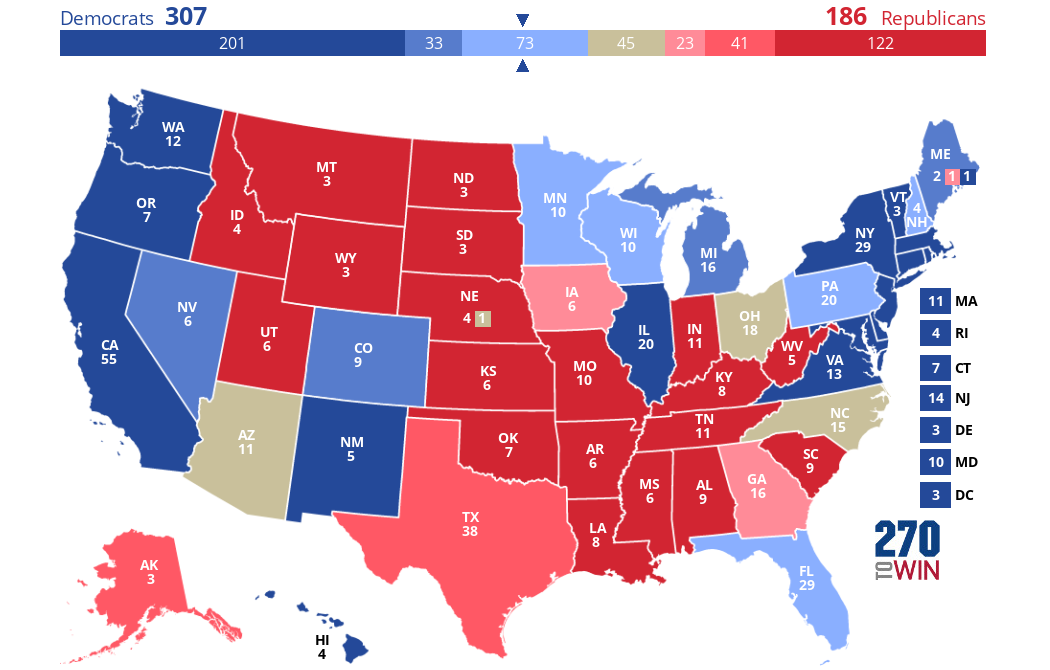
 Click the map to create your own at
Saturday, August 15, 2020
Saturday, November 10, 2012
The day after the election
I had begun this post the day after the election and have just finished it now. Here is a summary of the results along with some thoughts:
Results:
Presidential electoral college: Obama 332 Romney 206
Presidential popular vote: Obama 50% Romney 48%
Senate: Democrats 55 Republicans 45, a 2 seat gain for Dems
House of Representatives: Republicans 234 Democrats 194 TBD 7, previously was 242-193 Republicans
And a few details and thoughts:
-While not a huge win for Obama, it was a clear win, meaning the Republicans will have a hard time disputing the legitimacy of his Presidency (although I am sure some of them will try)
-Romney won the white vote 59-39%, while Obama won the black vote 93-7% and the Latino vote 71-27%. It is inevitable that the Republicans will have to start reaching out to minority voters if they ever want to win again, which will be a positive development for all. But don't expect it to happen too soon, as there is certain to be a battle brewing between tea partiers and more moderates in that party and so a firm change in direction won't happen until that has been settled.
-Obama won among women by a 55-43% margin, due in large part to Republicans' stance on birth control and abortion as well as comments by a couple of crazy Senators on rape.
-The Democrats gains in the Senate is remarkable considering they were defending seats compared to for the Republicans in a year that was not overwhelmingly favourable to them in comparison to 2006 and 2008. A big reason for this was the number of high quality candidates they nominated as compared to the relatively poor slate of Republican candidates.
-As expected, the Democrats will only pick up a few seats in the House. They will need to come up with a better strategy for winning this chamber in the future. This almost surely means the end of Nancy Pelosi's time as leader. From 2006 to 2010 the House was the more progressive than either the President or the Senate, in large part due to Pelosi who was Speaker at that time.
-Same sex marriage was on the ballot on four states. Maine, Maryland and Washington passed initiatives to allow same sex marriage while Minnesota rejected a proposal to define marriage as exclusively that of a man and a woman. Meanwhile Washington and Colorado voted to legalize marijuana and California passed a measure to allow tax increases that would go towards saving cuts to education and helping reduce the state's deficit.
-My thoughts on this election? It was a good result considering the current economic situation. Yes, the victories of 2006 and 2008 were larger, but the Democrats were aided by a very unpopular president and an unpopular war. It could very well have been a small blip in a country that was continuing to move to the right, a possibility underscored by the huge Republican gains of 2010. But the Democrats held up well this time and showed signs that their recent success was durable. Perhaps the country is ready to move to the left again after decades of moving to the right. While Republicans are now a party primarily white, male and southern, the Democrats have stitched together a much broader coalition, and have engaged parts of the population that had long been alienated and indifferent to the political process. I don't expect a sharp turn or that there will not be setbacks, but I do believe that this new, more progressive coalition of citizens will be dominant in American politics for a long time.
Results:
Presidential electoral college: Obama 332 Romney 206
Presidential popular vote: Obama 50% Romney 48%
Senate: Democrats 55 Republicans 45, a 2 seat gain for Dems
House of Representatives: Republicans 234 Democrats 194 TBD 7, previously was 242-193 Republicans
And a few details and thoughts:
-While not a huge win for Obama, it was a clear win, meaning the Republicans will have a hard time disputing the legitimacy of his Presidency (although I am sure some of them will try)
-Romney won the white vote 59-39%, while Obama won the black vote 93-7% and the Latino vote 71-27%. It is inevitable that the Republicans will have to start reaching out to minority voters if they ever want to win again, which will be a positive development for all. But don't expect it to happen too soon, as there is certain to be a battle brewing between tea partiers and more moderates in that party and so a firm change in direction won't happen until that has been settled.
-Obama won among women by a 55-43% margin, due in large part to Republicans' stance on birth control and abortion as well as comments by a couple of crazy Senators on rape.
-The Democrats gains in the Senate is remarkable considering they were defending seats compared to for the Republicans in a year that was not overwhelmingly favourable to them in comparison to 2006 and 2008. A big reason for this was the number of high quality candidates they nominated as compared to the relatively poor slate of Republican candidates.
-As expected, the Democrats will only pick up a few seats in the House. They will need to come up with a better strategy for winning this chamber in the future. This almost surely means the end of Nancy Pelosi's time as leader. From 2006 to 2010 the House was the more progressive than either the President or the Senate, in large part due to Pelosi who was Speaker at that time.
-Same sex marriage was on the ballot on four states. Maine, Maryland and Washington passed initiatives to allow same sex marriage while Minnesota rejected a proposal to define marriage as exclusively that of a man and a woman. Meanwhile Washington and Colorado voted to legalize marijuana and California passed a measure to allow tax increases that would go towards saving cuts to education and helping reduce the state's deficit.
-My thoughts on this election? It was a good result considering the current economic situation. Yes, the victories of 2006 and 2008 were larger, but the Democrats were aided by a very unpopular president and an unpopular war. It could very well have been a small blip in a country that was continuing to move to the right, a possibility underscored by the huge Republican gains of 2010. But the Democrats held up well this time and showed signs that their recent success was durable. Perhaps the country is ready to move to the left again after decades of moving to the right. While Republicans are now a party primarily white, male and southern, the Democrats have stitched together a much broader coalition, and have engaged parts of the population that had long been alienated and indifferent to the political process. I don't expect a sharp turn or that there will not be setbacks, but I do believe that this new, more progressive coalition of citizens will be dominant in American politics for a long time.
Tuesday, November 6, 2012
Election live blog
5:53 pm - Okay, I came home from work early today so that I can watch the results of the election come in, and decided I would live blog this thing as it seems this is what people with a political blog are supposed to do. My prediction? Obama wins the electoral college pretty easily. Of the states he won in 2008, he will only lose Indiana, North Carolina and Florida along with the one electoral vote from Nebraska. But it won't be apparent for a while as a number of states will be close. So let's see what happens.
6:27 pm - Joe Donnelly, Democrat, is leading over Richard Mourdock, his Republican opponent, by 48-46%. This is an interesting one, Mourdock seemed likely to win until his comment during a recent debate where he said rape was "God's will". Some Senate predictions in a few minutes, but the important Ohio polls are about to close now.
6:31 pm - Two encouraging exit polls for Obama. Not only did he out-poll Romney 51-48% in Ohio, but he was tied 49-49% in North Carolina.
6:34 pm - Before too many results come in, I am predicting that in the Senate, the Democrats will finish with one more seat than before the election: 54-46. They will pick up Maine, Massachusetts and Indiana but lose North Dakota and Nebraska. They will be less successful in the House of Representatives, picking up only a handful of seats (6-10), due in large part to redistricting in Republican controlled states. The Republicans will still hold a comfortable majority in that legislative body.
7:04 pm - A wave of states closing now. Obama now has 64 electoral votes and Romney has 40. But nothing unexpected so far. More interesting is the Florida exit poll where Obama came out ahead 50-49%. If Romney loses that, it is lights out. Actually is is looking very discouraging for Romney right now.
7:09 pm - As for the actual results in the states that matter, Obama leads Florida 51-49%, New Hampshire 64-35%, and Ohio 61-38%, while Romney is ahead in Virginia 59-40%. Most of these are still very early results, but 43% of polls in Florida are now in.
7:35 pm - Two states directly to the south of my province will have interesting races tonight. Romney will win in both Montana and North Dakota, but each could have very close Senate results. Six years ago, John Tester won the Senate seat in Montana by just over 3,000 votes. This year, polls say the results could be just as close between him and the Republican nominee, Denny Rehberg. Tester has had his success in this red state by portraying himself as sort of a populist libertarian.
In North Dakota, Democratic Senator Kent Conrad retired and this was expected to be an easy Republican pickup, however their candidate, Rick Berg, has proven to be a rather weak candidate while Democrat Heidi Heitkamp has proven to be quite popular.
I have predicted Tester will prevail in Montana, but it very well may be the closest race tonight. In North Dakota, I expect that the Republican candidate will prevail in the end in a state where the GOP is dominant.
7:54 pm - At 50-49% for Obama, could Florida be as close as it was in 2000? If so, Obama wins the election as there are several other swing states where he is stronger.
6:27 pm - Joe Donnelly, Democrat, is leading over Richard Mourdock, his Republican opponent, by 48-46%. This is an interesting one, Mourdock seemed likely to win until his comment during a recent debate where he said rape was "God's will". Some Senate predictions in a few minutes, but the important Ohio polls are about to close now.
6:31 pm - Two encouraging exit polls for Obama. Not only did he out-poll Romney 51-48% in Ohio, but he was tied 49-49% in North Carolina.
6:34 pm - Before too many results come in, I am predicting that in the Senate, the Democrats will finish with one more seat than before the election: 54-46. They will pick up Maine, Massachusetts and Indiana but lose North Dakota and Nebraska. They will be less successful in the House of Representatives, picking up only a handful of seats (6-10), due in large part to redistricting in Republican controlled states. The Republicans will still hold a comfortable majority in that legislative body.
7:04 pm - A wave of states closing now. Obama now has 64 electoral votes and Romney has 40. But nothing unexpected so far. More interesting is the Florida exit poll where Obama came out ahead 50-49%. If Romney loses that, it is lights out. Actually is is looking very discouraging for Romney right now.
7:09 pm - As for the actual results in the states that matter, Obama leads Florida 51-49%, New Hampshire 64-35%, and Ohio 61-38%, while Romney is ahead in Virginia 59-40%. Most of these are still very early results, but 43% of polls in Florida are now in.
7:35 pm - Two states directly to the south of my province will have interesting races tonight. Romney will win in both Montana and North Dakota, but each could have very close Senate results. Six years ago, John Tester won the Senate seat in Montana by just over 3,000 votes. This year, polls say the results could be just as close between him and the Republican nominee, Denny Rehberg. Tester has had his success in this red state by portraying himself as sort of a populist libertarian.
In North Dakota, Democratic Senator Kent Conrad retired and this was expected to be an easy Republican pickup, however their candidate, Rick Berg, has proven to be a rather weak candidate while Democrat Heidi Heitkamp has proven to be quite popular.
I have predicted Tester will prevail in Montana, but it very well may be the closest race tonight. In North Dakota, I expect that the Republican candidate will prevail in the end in a state where the GOP is dominant.
7:54 pm - At 50-49% for Obama, could Florida be as close as it was in 2000? If so, Obama wins the election as there are several other swing states where he is stronger.
Saturday, November 3, 2012
What to expect after the election
The U.S. election is now only three days away and it looks like Obama once again has a clear, if small, lead. The popular vote remains extremely close but he is leading the polls in enough states that he has become a clear favourite. Could Mitt Romney still win? It is certainly possible. National polls could turn out to be more correct than state polls, or turnout could favour Republicans more than expected. But neither seems likely.
It is easy to get caught up in the horse race of an election, and in American elections that is understandable. There is a clear difference between Republicans and Democrats at present, and the structure of American government makes it unlikely that a President could follow through on any specific policies he proposes anyways. Therefore, now more than ever, what is important in an election is to make sure your side wins.
Once the election is over, the attention of those of us who are interested will turn back to the issues. The question will become, what can we expect once the election is over? Should Obama win, he will be backed up, once again by a Democratic controlled Senate. A year ago, it appeared the Democrats would lose their majority, but they have done surprisingly well and it is even possible they could expand their majority. Not only that but they will likely be sending a more progressive delegation with possible newcomers like Elizabeth Warren, Chris Murphy and Tammy Baldwin. With the possibility of filibuster reform, the Senate could help an Obama agenda more than before.
Any major change, however, will be unlikely as the House of Representatives will almost certainly still be under Republican control. Already with a large majority, the expected handful of seats picked up by Democrats will change little to the composition of that legislative body. What could change is the direction of the majority party, their strategy of opposing everything the President proposes proving to be ineffective in preventing his election. But perhaps that is too much to expect.
That is not to say that important work will not get done. The president will now have a chance to implement and entrench "Obamacare", which will significantly affect the health care for most Americans for the better, despite its many flaws. He should be able to end the Bush tax cuts for the wealthy, putting the country in a much better position to get its deficit under control. That policy will be a key part of a likely strategy that will be worked out to curtail the growing problem of debt. It won't be a perfect deal, as there will likely be unnecessary cuts to important social programs, but it will be a much better strategy than would be implemented if Romney won. As for the critical issue of climate change, I am not holding my breath. From time to time people speculate that there may finally be an appetite to seriously deal with this issue, and each time they are proven wrong. Still, progress has been made under Obama, with increased investment in green technology increased substantially. I expect there will be even more progress on that during a second term.
The most likely result of this election, therefore, is more or less an entrenching of the policies already implemented in Obama's first term.
Monday, October 22, 2012
The presidential election tightens
I wish I had time to write more about the U.S. election, it has been an interesting campaign. Obama's small but consistent lead throughout most of the year had been growing prior to the first debate. Then a disastrous performance by Obama suddenly allowed Romney to, at least momentarily, pull ahead, and since then the race has been much closer with national polls nearly even and Obama with a slight edge in the most important states. Huffington Post has a feature where you can embed their poll tracking graphs, which I am going to use here. This is the national poll tracker:
As you can see, it has nearly been more or less a tie since October 5th. But Obama still has a slight advantage in the majority of the important swing states, including Ohio which is the state most likely to determine the winner:
Obama has a clear lead of two and a half percent. While Romney could win without Ohio, it would be very difficult. He is looking pretty strong in North Carolina and Florida right now, but would also have to win Virginia, Colorado, Iowa, New Hampshire and either Wisconsin or Nevada, and neither of the last two look promising for the GOP candidate right now. Still, anything is possible at this point. A higher or lower than expected turnout for one of the candidates, flaws in polling or a last minute shift in the polls could make for an unexpected result.
As you can see, it has nearly been more or less a tie since October 5th. But Obama still has a slight advantage in the majority of the important swing states, including Ohio which is the state most likely to determine the winner:
Obama has a clear lead of two and a half percent. While Romney could win without Ohio, it would be very difficult. He is looking pretty strong in North Carolina and Florida right now, but would also have to win Virginia, Colorado, Iowa, New Hampshire and either Wisconsin or Nevada, and neither of the last two look promising for the GOP candidate right now. Still, anything is possible at this point. A higher or lower than expected turnout for one of the candidates, flaws in polling or a last minute shift in the polls could make for an unexpected result.
Wednesday, September 5, 2012
Bill Clinton's speech; and the Quebec election results
I just watched Bill Clinton's speech at the Democratic National Convention and I can say I have rarely seen any better. In his familiar folksy manner he methodically picked apart the Republicans policies and criticism of Obama and countered them by building a case for why Obama's policies have been far better. Of course if there is anyone who can match Clinton's ability to make speeches, it is Barack Obama. It will be interesting to see what he says tomorrow night.
Of course, what I really wanted to talk about today were the events of yesterday's Quebec election and of the night that followed. But there is way to much to talk about and just not enough time to do it. Unfortunately I have been far too busy. Perhaps I will be able to touch on some of it in the days to come.
Of course, what I really wanted to talk about today were the events of yesterday's Quebec election and of the night that followed. But there is way to much to talk about and just not enough time to do it. Unfortunately I have been far too busy. Perhaps I will be able to touch on some of it in the days to come.
Thursday, August 30, 2012
Clint Eastwood portrays crazy old Republican voter
I haven't had much time to post here this past week, but I just couldn't resist this.
Honestly, this doesn't really make me think any less of Clint Eastwood, he is still a Hollywood legend. He just comes across as an old man who has lost his marbles, the same that will happen to many of us someday. But it does say something about the Republican party and the Romney campaign who can't seem to get anything right this election. At this point their defeat looks inevitable.
Honestly, this doesn't really make me think any less of Clint Eastwood, he is still a Hollywood legend. He just comes across as an old man who has lost his marbles, the same that will happen to many of us someday. But it does say something about the Republican party and the Romney campaign who can't seem to get anything right this election. At this point their defeat looks inevitable.
Monday, August 27, 2012
Republican convention satire
Republicans gather in Tampa, Florida for their convention this week at just about the same time Hurricane Isaac is scheduled to hit the state, and comedian Andy Borowitz, in his satirical column for the New Yorker, has this to report:
TAMPA (The Borowitz Report)—With Hurricane Isaac heading towards the site of the 2012 Republican National Convention, presumptive G.O.P. nominee Mitt Romney today called for the government to respond with a round of “emergency tax cuts.”
“If this hurricane is as powerful as predicted, it could destroy many people’s second and third homes,” Mr. Romney said. “In that worst-case scenario, it would be inhumane to ask them to pay more than thirteen per cent.”You can read the rest here.
Saturday, August 25, 2012
Presidential elections now fought over a small number of voters
If there is a theme to this year's U.S. presidential election, it is Barack Obama's small but consistent lead over Mitt Romney. It really is a sign of the current polarization of politics in America, where parties fight over a small number of undecided voters. It is a trend that has its roots in the divisive politics of the Gingrich lead Republicans in the 90s and accelerated with the election of George W. Bush in 2000. Even Obama's "landslide" win in 2008 was smaller than landslides of past eras and only made possible by the unprecedented unpopularity of Bush and a weak Republican candidate in John McCain. Obama won in 2008 with 53% of the vote compared to John McCain's 46% of the vote and with 365 electoral votes compared to 173. Compare that with Ronald Reagan's 1984 win over Walter Mondale in which Reagan carried every state but Minnesota and the District of Columbia, or Richard Nixon's 1972 win over George McGovern in which Nixon won the popular vote by a 61% to 38% margin and again won every state save for Massachusetts and DC. Today over half the states are automatic wins for one party or another. The chart below illustrates this trend more clearly. Democrat winners are in blue and Republican winners are in red. (I apologize for my poor Blogger skills, they don't make it easy to make tables)
Year Dem. candidate Rep. candidate popular vote electoral vote states won
1964 Johnson Goldwater 61 - 39 486 - 52 44 - 6
1968* Humphrey Nixon 43 - 43 301 - 191 32 - 13
1972 McGovern Nixon 61 - 38 520 - 17 49 - 1
1976 Carter Ford 50 - 48 297 - 240 23 - 27
1980 Carter Reagan 51 - 41 489 - 49 44 - 6
1984 Mondale Reagan 59 - 41 525 - 13 49 - 1
1988 Dukakis GHW Bush 53 - 46 426 - 111 40 - 10
1992 Clinton GHW Bush 43 - 38 370 - 168 32 - 18
1996 Clinton Dole 49 - 41 379 - 159 31 - 19
2000 Gore GW Bush 48 - 48 271 - 266 30 - 20
2004 Kerry GW Bush 51 - 48 286 - 251 31 - 19
2008 Obama McCain 53 - 46 365 - 173 28 - 22
(* in 1968 American Independent candidate George Wallace captured 5 states and 46 electoral votes with 14% of the popular vote)
The trend is quite obvious, the popular vote has become increasingly close, on average, while at the same time as like minded people become more and more concentrated in the same places, the number of safe states have increased for both parties (although the increase in states now out of play have been more pronounced for the Democrats). As the number of voters that can be influenced continues to dwindle, elections will continue to be fought in a handful of states where the two parties are more or less evenly matched.
Year Dem. candidate Rep. candidate popular vote electoral vote states won
1964 Johnson Goldwater 61 - 39 486 - 52 44 - 6
1968* Humphrey Nixon 43 - 43 301 - 191 32 - 13
1972 McGovern Nixon 61 - 38 520 - 17 49 - 1
1976 Carter Ford 50 - 48 297 - 240 23 - 27
1980 Carter Reagan 51 - 41 489 - 49 44 - 6
1984 Mondale Reagan 59 - 41 525 - 13 49 - 1
1988 Dukakis GHW Bush 53 - 46 426 - 111 40 - 10
1992 Clinton GHW Bush 43 - 38 370 - 168 32 - 18
1996 Clinton Dole 49 - 41 379 - 159 31 - 19
2000 Gore GW Bush 48 - 48 271 - 266 30 - 20
2004 Kerry GW Bush 51 - 48 286 - 251 31 - 19
2008 Obama McCain 53 - 46 365 - 173 28 - 22
(* in 1968 American Independent candidate George Wallace captured 5 states and 46 electoral votes with 14% of the popular vote)
The trend is quite obvious, the popular vote has become increasingly close, on average, while at the same time as like minded people become more and more concentrated in the same places, the number of safe states have increased for both parties (although the increase in states now out of play have been more pronounced for the Democrats). As the number of voters that can be influenced continues to dwindle, elections will continue to be fought in a handful of states where the two parties are more or less evenly matched.
Subscribe to:
Posts (Atom)